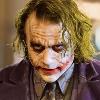
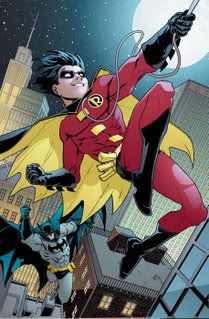
I have somethings you can add to the Joker Bio i did a school project on him some of the stuff i wrote and some is from various sites.
The maniacal Joker is Batman's most dangerous foe. Unpredictable, murderous and surprisingly cunning, the Joker is a threat to both heroes and villains alike.
From Wizard Magazine issue #177:
(I only put in essential passages) "#1 Greatest Villian Of All Time:
With his pasty white skin, oily green hair and lanky stickman body, the scariest villian of all isn't an alien warlord or a cosmic god - he's just a guy with a smile carved across his face. From defacing and defiling art to rape to murder to serial killing to torture and mass genocide or worse, the Joker stands as the most feared villian ever and he thinks it's funny. Villians like Luthor just go after the hero whilst Joker drags supporting casts into his attacks. He even trumps the Green Goblin by him brutally
slaughtering Jason Todd (Robin II) and blood soaking his trademark purple gloves. Many complain that the street level badguys could never amount to "bigger" threats like Darkseid or Thanos but they'd be wrong. Once after stealing the reality warping powers of Mr. Mxyztplk, Joker reacreated the universe in his own image. With ultimate power in his hands, he
spent every day torturing, killing and resurrecting Batman. He even went so far as destroying the cosmos just to mold it back together and destroy it again. But the colossal capers aren't what makes the Joker the most gruesome villian of all.He is a brilliantly overpowering mastermind with the highest death count of any rogue. And the scariest part? All the death and destruction is a joke. The horrors he commits aren't for gain. He does it because it's hilarious and the choas and suffering make him laugh."
Characteristics
Joker
Height: 6' 5" (1.95 m)
Weight: 192 lbs (87 kg)
Eyes: Green
Hair: Green
Skin: Powder White
Unusual Features: The Joker's facial nerves are paralyzed, which makes him appear as if he is persistently grinning. The chalk white skin and green hair due is to chemical exposure.
Powers
Known Powers: It is speculated that the Joker's exposure to chemicals may have heightened his resistance to pain.
Known Abilities: The Joker seems to have extensive knowledge of explosives, science, chemistry, and art. While not a trained fighter, he is fairly skilled with knives and other weapons.
Strength Level: Athletic.
Notes
* His name starts with "Ja." Rumored to be Jack Napier, but that is mostly from the movie and the animated series. There is no canonical source that indicates this to be a fact.
* The Joker has one of the most extensive body counts of any comic book villain (notwithstanding incidents were entire cities were nuked).
* The Joker who is the greatest enemy of Batman, is a murderously insane supervillain with a disturbing clown-like appearance. Appeared in Batman #1 (1940), three decades before John Wayne Gacy.
Every classic literary hero has that one great villain: Robin Hood has his Sheriff of Nottingham, King Arthur his Mordred, Sherlock Holmes his Moriarty. Although Batman has probably the most famous and well-rounded Rogues Gallery in all of comics, when it comes to Batman villains, there is one name and one name alone at the top of the list. As we begin our discussion of the Batman's enemies, it s only appropriate that we start things off with the main event: the Clown Prince of Crime, the Joker.
The Joker first appeared in BATMAN #1 (1940), courtesy of writer Bill Finger and artists Bob Kane and Jerry Robinson. Credit for the actual creation of the character has long been a bone of contention between Kane and Robinson. Robinson has claimed the inspiration came from a pack of playing cards, while Kane claimed to have come up with the character on his own. As for Finger, his contribution to the character can not be denied. Finger, who was known for keeping a truly enormous reference file, rejected Kane's initial sketch for the new villain as too clown-like, and provided the artists with photo stills from the 1928 film THE MAN WHO LAUGHS, which starred Conrad Veidt as an English nobleman who has had an unsettling smile permanently carved into his face. The makeup worn by Veidt was most creepy, and a clear inspiration for the Joker's appearance. Note particularly the bags under the eyes, the creased brow and distinctive high hairline.
The Joker is a fictional character, a DC Comics supervillain widely considered to be Batman's archenemy. He first appeared in Batman #1 (Spring 1940). His creation is the subject of debate, with some sources saying he was initially conceived by art assistant Jerry Robinson and redesigned by Batman creators Bob Kane and Bill Finger, which Kane consistently denied until his death in 1998. The Joker is a master criminal with a clown-like appearance. The earliest and most recent writers depict him as a violent sociopath who murders people for his own amusement. The Joker has been responsible for numerous tragedies in Batman's life, including the paralysis of Barbara Gordon (Batgirl) and the murder of Jason Todd (the second Robin). Interpretations of the Joker in other media include Jack Nicholson's in Tim Burton's 1989 feature film, and Mark Hamill's in Batman: The Animated Series, as well as other DC Animated Universe shows. The Joker ranks #1 in Wizard's list of the top 100 villains of all time.
Originally conceived as an evil "court-jester" type, the character was initially rejected by studio writer Bill Finger as being "too clownish," but he later relayed the idea to Bob Kane. Kane, who started out as a gag artist, loved the concept and encouraged its production. Finger found a photograph of actor Conrad Veidt wearing make-up for the silent film The Man Who Laughs, and it was from this photograph that the Joker was modelled. This influence was later admitted by Kane in 1970 and referenced in the graphic novel Batman: The Man Who Laughs, a retelling of the first Joker story from 1940.
As with Batman himself, credit for creation of his the Joker is disputed. Kane responded in a 1994 interview to claims that Jerry Robinson created the character:
?Bill Finger and I created the Joker. Bill was the writer. Jerry Robinson came to me with a playing card of the Joker. That's the way I sum it up. [The Joker] looks like Conrad Veidt ? you know, the actor in The Man Who Laughs.Bill Finger had a book with a photograph of Conrad Veidt and showed it to me and said, 'Here's the Joker'. Jerry Robinson had absolutely nothing to do with it. But he'll always say he created it till he dies. He brought in a playing card, which we used for a couple of issues for the Joker to use as his playing card".
In his initial dozen or so appearances, starting with Batman #1 (1940), the Joker is a straightforward spree killer/mass murderer, with a bizarre appearance modeled after the symbol of the Joker known from playing cards. It is of note that in his second appearance ("The Joker Returns", also in Batman #1), the Joker was actually slated to be killed off, with the final page detailing the villain accidentally stabbing himself. DC editor Whitney Ellsworth thought the Joker was too good a character to kill off, suggesting that he be spared. A hastily drawn panel, calculated to imply that the Joker was still alive, was subsequently added to the comic.
For the next several appearances, the Joker often escapes capture but suffers an apparent death (falling off a cliff, being caught in a burning building, etc.), from which his body was not recovered. In these first dozen adventures, the Joker kills close to three dozen people, impressive for a villain who didn't use giant robots, mutants, monsters and crap like that, as was the status quo between 1940 until around 1942. Ironically, the turning point came in "Joker Walks the Last Mile" (Detective Comics #64), when the Joker is actually executed in the electric chair only to be chemically revived by henchmen.
In 1973, the character was revived and profoundly revised in the Batman comic stories by Dennis O'Neil and Neal Adams. Beginning in Batman #251, with the story "The Joker's Five Way Revenge", the Joker is a homicidal maniac who casually murders people on a whim, while enjoying battles of wits with Batman. This take on the character has taken prominence since. Steve Englehart, in his short but well-received run on the book, added elements deepening the severity of the Joker's insanity.
Joker even had his own nine-issue series during the 1970s in which he faces off against a variety of foes, both superheroes and supervillains. Although he was the protagonist of the series, certain issues feature just as much murder as those in which he was the antagonist; of the nine issues, he commits murder in seven. The development of the Joker as a psychopath continues with the issues "A Death in the Family" (in which readers voted for the character to kill off Jason Todd) and The Killing Joke in 1988, redefining the character for DC's Modern Age after the company wide reboot following Crisis on Infinite Earths.
A major addition to the character was the introduction of Harley Quinn. Originally introduced in Batman: The Animated Series, Quinn is a clinical psychiatrist who falls hopelessly in love with the Joker in Arkham Asylum and now serves as his loyal, goofy sidekick, costumed in a skintight jester/harlequin suit. Their relationship often resembles that of an abusive domestic relationship, with the Joker insulting, hurting, or even attempting to kill Quinn, who remains undaunted in her devotion. She was popular enough to be integrated into the comics in 1999 and modified the character to be less daffy, but still criminally insane and utterly committed to the Joker.
The Joker has been referred to as the Clown Prince of Crime, the Harlequin of Hate, and the Ace of Knaves. The original and currently dominant image of The Joker is that of a sadistic, fiendishly intelligent lunatic with a warped sense of humor, deriving pleasure from inflicting twisted, morbid death, torture, and terror upon innocent people. In this, he is a textbook example of antisocial personality disorder; in a sense, he is Charles Manson cursed with a clown's grinning face and a grotesque sense of showmanship.
The Dark Knight Dective (Batman) is depicted as a dark, brooding and revenge obsessed humorless avenger who pursues justice and vengeance as an enigmatic shadow striking from the dead of night. The Joker, by contrast, is symbolized as a killer clown, driven by a disordered mind to pursue destruction and chaos with as much panache flair and "artistic style" as possible. His appearance and actions suggest the bright and garish pomp and circumstance of the circus. Nightwing has stated that he believes the Joker and Batman exist because of each other; that Batman represents order and Joker the chaos that challenges it. Like Superman and Lex Luthor, it has been suggested that Batman and the Joker need each other.
The Joker's victims have included men, women, children, animals, babies, infants, and even his own henchmen. An issue of Hitman in 1996 stated that the Joker had once gassed and murdered an entire kindergarten class. In the graphic novel The Joker: Devil's Advocate, the Joker is stated as having killed well over two thousand people. Despite having murdered enough people to get the death penalty thousands of times over, he is always found not guilty by reason of insanity. In the Batman story line "War Crimes", this continued ruling of insanity is in fact made possible by The Joker's own dream team of lawyers, an indication of his great intelligence. He is then placed in Arkham Asylum, from which he appears able to escape at will. In fact, it is hinted the Joker will deliberately allow himself to be captured so he can "unwind" at Arkham before his next scheme.
There have been times when Batman has been tempted to put the Joker down once and for all, but has relented at the last minute. After capturing the Joker in one story, he threatens to kill his old foe, but then says, "But that would give you the final victory, making me into a killer like yourself!"
The Joker's obsession with Batman, and vice versa, is somewhat unique compared to other superheroes and villains:
* The Joker has also said that without Batman, his life is nothing.
* In Batman: The Dark Knight Returns, a catatonic Joker becomes animated only after seeing a police report that Batman has returned to action, setting in motion a final confrontation.
* In another issue, the Joker threatened to kill crime boss Rupert Thorne if he uncovered Batman's secret identity. Thorne had Hugo Strange discover Batman's identity, but, when Strange would not tell him who Batman was, had him killed. The Joker, who was also bidding for Batman's identity alongside the Penguin, told Thorne he was lucky Strange took whatever secrets he held with him to the grave; he explained that he was destined to defeat Batman in a manner worthy of his criminal reputation, and that no one else had the right.
The Joker is renowned as Batman's most unpredictable foe. While other villains rely on tried-and-true methods to commit crimes (such as Mr. Freeze's freeze gun or Poison Ivy's toxic plants), Joker has a variety of weapons at his disposal. For example, the flower he wears in his lapel sprays (at any given time) acid, Joker Venom (poisonous laughing gas or liquid), or nothing at all. In Batman Beyond: Return of the Joker and much earlier in "Dreadful Birthday, Dear Joker-!" (Batman #321), the Joker has a gun which at first shoots a flag saying "BANG!", but then, with another pull of the trigger, the bullet fires. His most recurring gadget is his high-voltage hand-buzzer where he literally electrocutes his victims with a handshake. Sometimes he commits crimes just for the fun of it, while on other occasions, it is part of a grand scheme; Batman has been noted to say that the Joker's plans make sense to him alone.
Origin
Detective Comics #168 (February 1951) revealed that he had been a criminal known as the Red Hood. While fleeing from Batman, the Red Hood fell into a vat of chemicals, from which he emerged with white skin, green hair, and a bizarre grin.
Though many have been related, a definitive history of the Joker has never been established in the comics, and his true name has never been confirmed. The most widely cited backstory can be seen in Alan Moore's The Killing Joke. It depicts the Joker as originally being an chemical engineer/chemist at a chemical plant who quit his job to pursue his dream of being a stand-up comedian, only to fail miserably. Desperate to support his pregnant wife, the unnamed engineer agreed to help two criminals break into the plant where he was worked at. In this version of the story, the Red Hood persona is given to the inside man of every job (thus it is never the same man twice); this makes the leader appear to be the inside man, allowing the two ring-leaders to escape. The men convinced the engineer to wear it by saying it was out of their concern for his identity. During the planning, police contacted and informed him that his wife had died in a household accident.
Stricken with grief, he attempted to back out of the plan, but the criminals forced him into keeping his promise. As soon as they entered the plant, however, they were immediately caught by the security and a fatal shoot-out followed in which the two criminals were killed. As he tried to escape, the engineer was confronted by Batman, who was investigating the disturbance. When in panicked fear the chemist saw Batman and thought him to be a Demon from Hell sent to punish him he dove into a vat of chemicals.When he surfaced in the nearby reservoir, he removed the hood and saw his reflection: bleached chalk-white skin, ruby-red lips, and green hair. These events, coupled with his other misfortunes that day, drove the scientist completely insane, resulting in the birth of the Joker.
In the story "Pushback" (Batman: Gotham Knights # 50-55), supports part of the Moore version when a witness (who coincidentally turns out to be Edward Nigma, a.k.a. The Riddler) recounts that the Joker's wife was kidnapped and murdered by the criminals in order to force the engineer into performing the crime. In this version, the Joker was called Jack.
No recounting of the Joker's origin is exactly definitive, however, as he is portrayed as lying so often about his former life that he himself is confused as to what actually happened. As he says in The Killing Joke: "Sometimes I remember it one way, sometimes another... if I'm going to have a past, it might as well be multiple choice!"
Criminal career
From the Joker's first appearance in Batman #1, he has been willing and eager to wreak as much havoc as possible upon innocent people in order to claim the mantle of Gotham City's greatest criminal mastermind. Throughout his decades-long war with Batman, he has committed crimes both whimsical and inhumanly brutal, all with a logic and reasoning that, in Batman's words, "make sense to him alone."
In The Killing Joke, the Joker appeared at Commissioner Gordon's home one night and shot Barbara Gordon in the stomach at close range, paralyzing her, and kidnapped the Commissioner. The Joker stripped Barbara naked beat and tortured her and took photographs of her injured body and videotaped the torture, which he would later show to Gordon in his attempt to drive him insane; Joker sought to prove that any man can have "one really bad day" and become just like him.Batman rescued Gordon before pursuing the Joker, eventually cornering him on the rooftop. Batman tried one final time to reach his old foe, offering to rehabilitate him. The Joker refused, but showed his appreciation by sharing a joke with Batman, and the two began to laugh before Joker allowed himself to be taken back to Arkham.
One of the Joker's biggest impacts on Batman's life was the murder of Jason Todd, the second Robin in the story "A Death in the Family". In his search for his long lost mother, Todd eventually found her in the captivity of the Joker. Joker beat Jason with a crowbar to within an inch of his life and beat and terrorized Jason's mother before blowing up the warehouse they were in. Joker escaped but Batman was left to find the lifeless body of the second Robin, a death which haunts him to this day and intensified his obsession with his archenemy.
A psychiatrist is Harleen Quinzel, the future Harley Quinn. As she tries to treat the Joker, he recounts a tale of an abusive father and runaway mother to gain her sympathy. It works all too well; she falls hopelessly in love with him, and allows him to escape Arkham several times before she is eventually caught. Driven over the edge with obsession, she turns into a criminal and the Joker's on and off girlfriend.
In a company-wide crossover, "The Last Laugh," the Joker believed himself to be dying and plans one last historic crime spree, infecting the inmates of 'The Slab,' a prison for super criminals, with Joker Venom before escaping. He sets the super powered inmates loose on the world to cause mass chaos in their 'Jokerized' forms. Meanwhile, he tries to ensure his "legacy" by defacing statues in his image and attempting to impregnate Harley Quinn. The entire United States declares war on the Joker under the orders of President Luthor; in response, Joker sends his minions to kill the President. The heroes of the world try to fight off the rampaging villains, while Black Canary discovers that Joker's doctor modified his CAT scan to make it appear that he had a fatal tumour in an attempt to subdue him with the threat of death. Meanwhile, Harley Quinn, angry at Joker's attempt to get her pregnant, is helping the heroes who rescued her to create a cure to the Joker poison and return the super villains to their normal state and eventually comes up with an antidote.
Nightwing eventually catches up with the Joker and, believing that Robin is dead, prepares to take the villain down once and for all. The Joker, happy to end his life by killing the first Robin, faces Nightwing in a physical one on one, a match that Nightwing easily dominates. Nightwing finally kills the Joker, just as Batman and his allies arrive. Refusing to allow the Joker to escape justice, Batman revives the Joker and sends him back to Arkham Asylum. The super criminals are all cured of their Jokerized forms. During the events of the No Man's Land storyline, the Joker murders Sarah Essen Gordon, Commissioner Gordon's second wife, by shooting her through the head as she tries to protect infants that he had kidnapped. James Gordon retaliates by shooting Joker in the leg. The Joker begins to laugh, seeing the irony in losing the use of his leg after he paralyzed Barbara Gordon years earlier.
"One Year Later", Batman #655 opens with Joker having poisoned Commissioner Gordon and apparently having beaten Batman to death while disabled children he had taken hostage were forced to watch. He had also shattered the Bat-signal. However, the Batman he had beaten was a fake, an ex-cop in a Batman suit. Moreover, he was not dead, and pulled a gun. Batman was in time to save the Joker, but not before the bullet grazed his forehead. Batman took out his frustration by throwing him into a Dumpster.
After tricking the fifth-dimensional being Mister Mxyzptlk into giving all of his power to the Clown Prince of Crime, the Joker briefly had the ability to alter reality, a power he uses to remake the world and torture Batman until Superman and a chagrined Mister Mxyzptlk return reality to normal.
Powers and abilities
The Joker commits crimes with countless "comedic" weapons (such as razor-sharp playing cards, acid-spewing flowers, and lethally electric joy buzzers) and Joker Venom, a deadly poison that infects his victims with a ghoulish rictus grin as they die while laughing uncontrollably. This venom comes in many forms, from gas to darts to liquid poison, and has been his primary calling card from 1940 till the present. The Joker is immune to his venom, perhaps due to physiological changes beyond his appearance but more likely because he has vaccinated himself with the antidote. The Joker is also very skilled in the fields of chemistry, genetics, and computer technology. The Joker can and will use any weaponry available to him, however, from joke pistols to nuclear bombs.
Joker's skills in hand-to-hand combat vary considerably, with his ability to hold his own during physical confrontations often depending on the writer.
The Joker has cheated death numerous times, even in seemingly inescapable and lethal situations. Though he has been seen to "die" through explosions, has been repeatedly shot, dropped from heights and through various other means, the Joker always manages to return fully alive and unscathed to wreak havoc again.
Over several decades there have been a variety of depictions and possibilities regarding the Joker's apparent insanity, of which the following are a sampling:
During the Knightfall saga after the Scarecrow and the Joker team up and kidnap the mayor of Gotham City, Scarecrow turns on the Joker and uses his fear gas to see what Joker is afraid of. To Scarecrow's surprise the gas has no effect on Joker, who in turn beats Scarecrow with a chair. This suggests that due to his insanity, the Joker literally has no fear, or at least has no hidden demons.
It is often implied that the Joker was transformed both physically and mentally by the accident in the chemical plant. In various DC Comics Who's Who publications, it has been stated that due to his level of insanity, at times the Joker manifests a degree of superhuman strength.
The character is sometimes portrayed as having a heightened sense of self-awareness that other characters do not, such as being aware of being in a comic book. This fourth wall awareness also seems to carry over to Batman: The Animated Series. The Joker is the only character to talk directly into the "camera", and can be heard whistling his own theme music in the episode adaptation of the comic Mad Love. In the Marvel vs DC crossover, he also demonstrates knowledge of the first Batman/Spider-Man crossover even though that story's events did not occur in the canonical history of either the Marvel or DC universe.
Alternate versions
* In Batman: Bloodstorm, the sequel to Batman's fight with Dracula that resulted in him being transformed into a vampire, the Joker took charge of the remaining vampires, convincing them that he was a better leader to them alive and thinking long-term than transformed into a vampire and more concerned with his next meal. Under the Joker's leadership, the vampires killed all of Gotham's major crime families, but this made them easy prey for Batman's daylight allies. In a last stand, the Joker's remaining vampire allies were killed, but the Joker managed to kill Catwoman in the process. Driven mad with grief, Batman broke the Joker's neck and drained his blood, committing his first murder as a vampire. Horrified by what he had done, Batman fled after staking the Joker, but knew that, in his last breath, the Joker had won by turning Batman into a monster.
* In JLA: The Nail, the Joker was given access to Kryptonian weaponry by the altered Jimmy Olsen, using it to kill Batgirl and Robin right in front of Batman, tearing them apart as he forced Batman to watch. However, the intervention of Catwoman made the Joker lose his concentration, freeing the grief-striken Batman who, driven to the brink of madness with the horror of what he had seen, killed the Joker on the roof of Arkham Asylum. In the sequel, JLA: Another Nail, they have a rematch in Hell.
* In Batman: In Darkest Knight, where Bruce Wayne is chosen as Green Lantern instead of Hal Jordan, he easily averts the accident that initially transformed the criminal who was once the Red Hood into the Joker.
Batman: The Animated Series
The Joker as he appeared in Batman: The Animated Series. His voice was provided by Mark Hamill.
Batman: The Animated Series - mainly in the episode Beware the Creeper and the spin-off movie Batman: Mask of the Phantasm - offers another version of the Joker's history: He is portrayed as a former anonymous hitman for the Mafia with ties to the Beaumont family, later the one who killed Carl Beaumont. As in the 1989 movie, he was not wearing any disguise when he made his fateful attempt to rob the chemical factory. In both the Animated Series and the related comics, the Joker recalls that Batman intentionally pushed him into the chemicals. Unlike the 1989 movie, however, no attempt has been made to connect him with the death of Bruce Wayne's parents (although "Jack Napier" has been mentioned as one of the hitman's aliases, notably in the episode "Dreams in Darkness", in which Arkham's psychiatrist calls Joker "Jack Napier" .
In Batman: The Animated Series, the Joker made the most appearances of any villain in Batman's rogues' gallery, helping solidify his presence as the Batman's arch-foe. The relationship between Batman and Joker in the animated universe is one of a constant back-and-forth as to who is really angering the other. Often, it is the Joker that aggravates Batman, with the Joker thrilling at Batman's glowering inappreciation of his "comedy". Once in a while, though, Batman or Robin manages to get the upper hand, as in "Mad Love" or "Harlequinade", finally provoking the Joker into losing his cool evidenced that he loses his temper to Harley for stealing his routines. Like his comic book persona, the Joker in the animated series is obsessed with Batman; he often says he is the only one who "deserves" to take out Batman, halting those who try or punishing those who he thinks beat him to it.
The Animated Series version of the Joker also appears in the Static Shock episode "The Big Leagues". Joker traveled to Dakota, home of Static, to recruit a few bang babies for assistance in battling Batman, Robin, and Static. In the end, Static defeated Joker, who was taken back to Arkham Asylum.
Justice League
In the Justice League episode "Injustice for All" , the Joker became a member of the Injustice Gang after Copperhead was arrested. In the episode "Wild Cards" , the Joker placed a series of bombs all over Las Vegas closed of all the roads and attempted to murder everyone in the city, the Justice League had less than 30 minutes to defuse while they were watched on TV all over the country. However, the Royal Flush Gang were sent by the Joker to stop the League. When all but one of the Royal Flush Gang were defeated and all of the bombs were disposed of, the Joker revealed his true plan: to use Ace's powers to drive people insane just by looking at them.
Joker venom
Joker venom is a fictional toxin, a favourite murder weapon utilised by The Joker in the Batman franchise of movies, comics, and cartoons.
Analysis
Joker venom can exist in liquid and gas states and has been used to great effect. The gas form is slightly denser than air and in some portrayals dissipates over time.
The DC Technical Manual: S.T.A.R. Labs 1993 Annual Report (a sourcebook for Mayfair's DC Heroes Roleplaying Game) stated that Joker Venom is "a hellish mixture of hydrogen cyanide and Strychnodide (a strychnine derivative), the toxin causes immediate cessation of heart and brain functions. As a side effect, the victim's muscles contract in such a way as to severely tighten and discolor the victim's skin, especially in the facial area. This leaves the victim's corpse permanently scarred with a clown-like grin in tribute to his killer. Since the Joker Venom is just as deadly if absorbed through the pores as it is if inhaled, the Joker occasionally releases it in gas form throughout the central heating/cooling vents of a building."
How exactly Joker knows how to make the venom varies by story. In the graphic novel Batman: The Killing Joke, it was revealed that the man who would become the Joker once worked in a chemical plant, and may have had some chemical education as a result. In the 1989 movie, when Bruce Wayne reads through the police file on Jack Napier, he learns that Napier, despite his criminal ways, is extremely intelligent and especially gifted in chemistry. Napier, who became the Joker, was inspired to make the poison after reading testing reports on a nerve-effecting chemical that was (presumably) a component in the vat mixture caused his metamorphosis.
In a 1980s comic book, the Joker facilitates one of his many escapes from Arkham Asylum using the venom - by mixing together the common cleaning chemicals found in a janitor's closet.
Effects
* Lethal version
Contact with Joker venom causes uncontrollable spasms of laughter and then causes a very painful death. Some have speculated that the venom hyperstimulates the laughter functions of the brain and the victim is unable to breathe.
* Non-lethal version
Prolonged exposure to the non-fatal forms can cause permanent brain damage and endless pain and suffering.
The faces of victims are usually pulled into a huge grin. Artists often stylize the effects, adding yellowed teeth, bulging eyes, etc. similar to the features of the Joker himself.
Usage
* Comics
Joker venom has been a part of the Joker's arsenal since his first appearance in Batman #1 (1940). The venom is often deployed as an airborne agent, but can also be used in its liquid form (used both to poison victims through their unwitting consumption of it, or in special darts). In Batman: The Killing Joke, Joker was seen to use a spike worn in his palm (similar to a Joy Buzzer) to administer the drug in a handshake manner.
* Batman: The Animated Series
In the 1990s animated series the venom became lethal (it was used to kill, among others, Sal Valestra in Mask of the Phantasm, three security guards in "Holiday Knights" and all personnel in a military complex in the Justice League episode "Wild Cards", although Joker also used the non-lethal variant as well. Joker did not appear to be immune to it, as evidenced by his protective helmet in "The Last Laugh" (although this may have been an oversight - later episodes showed him breathing and even talking while the gas is in the air around him). Poison Ivy, however, did display immunity towards it due to her immune system's resistance to toxins.
* Batman (1989 film)
Renamed Smylex, exposure to the Joker Venom in this example was fatal. It was distributed both as a gas and in liquid form, mixed as separate components in various beauty and hygiene products which only took effect when the victim used a number of them in tandem, thus making the toxin impossible to trace. The Joker shows no immunity to it here, and can be seen in a gas mask in the parade scene, where he uses a gas form on a large scale.
Cures
It has been stated that the Joker constantly alters the formula to the Venom (which he is immune to) so no antidote can be prepared for it. However, there have been some antidotes concocted. Gotham Police Commissioner Jim Gordon had been poisoned with the venom; and was successfully saved. It took days for the effects of the venom to get completely out of his systems. During that time, he found dark humour funny; although normally, that would be out of character for him.
"I Am Vengeance I Am The Night I Am Batman"
Edited by Bat-Man on 22-02-2007 04:52
BATMAN: Yesterday, Today, & Beyond, all of it's sub-sites, or hosted sites are in no way associated, or affiliated with DC Comics, Time Warner or any of it's divisions.
Items cataloged in merchandise sections are not for sale. The downloading of video game ROMs is for backup and testing purposes only. If you do not own the actual game, the ROM is to be deleted from your hard drive within 24 hours.
Any money that may be made from Amazon Associates, advertisements, or affiliate programs will be contributed to the maintaining of this website, to provide the fans with the best that we can offer.





 Home
Home



 .
.